
Kathak
Home / Kathak
History
Kathak
Classical Kathak dance is a revered and intricate art form that finds its roots in Northern India, particularly in the region of Uttar Pradesh. With a rich history and cultural heritage, Kathak has evolved over centuries into a mesmerizing and versatile expression of artistic storytelling.
Derived from the Sanskrit term “Katha,” meaning story, Kathak lives up to its name by being a narrative-driven dance form that conveys emotions through graceful movements, rhythmic footwork, intricate hand gestures, facial expressions, and musicality.
The origins of Kathak can be traced back to the Kathakars, ancient storytellers who entertained and educated audiences through their performances. Over time, these storytellers incorporated elements of dance, music, and dramatic enactment, giving rise to the distinct art form we know today as Kathak.
One of the defining features of Kathak is its emphasis on rhythmic footwork, often known as “tatkar.” Dancers create elaborate patterns and rhythms with their feet, accompanied by the melodious sound of ankle bells, or “ghungroos.” This intricate footwork is complemented by precise hand movements, or “hasta,” each gesture carrying its unique meaning and symbolism.
Another hallmark of Kathak is the artful execution of spins, known as “chakkars.” Kathak dancers are lauded for their mastery of rapid and controlled spins, showcasing their impeccable balance, control, and coordination. These dynamic pirouettes add an entrancing element to performances, captivating audiences with their fluidity and grace.
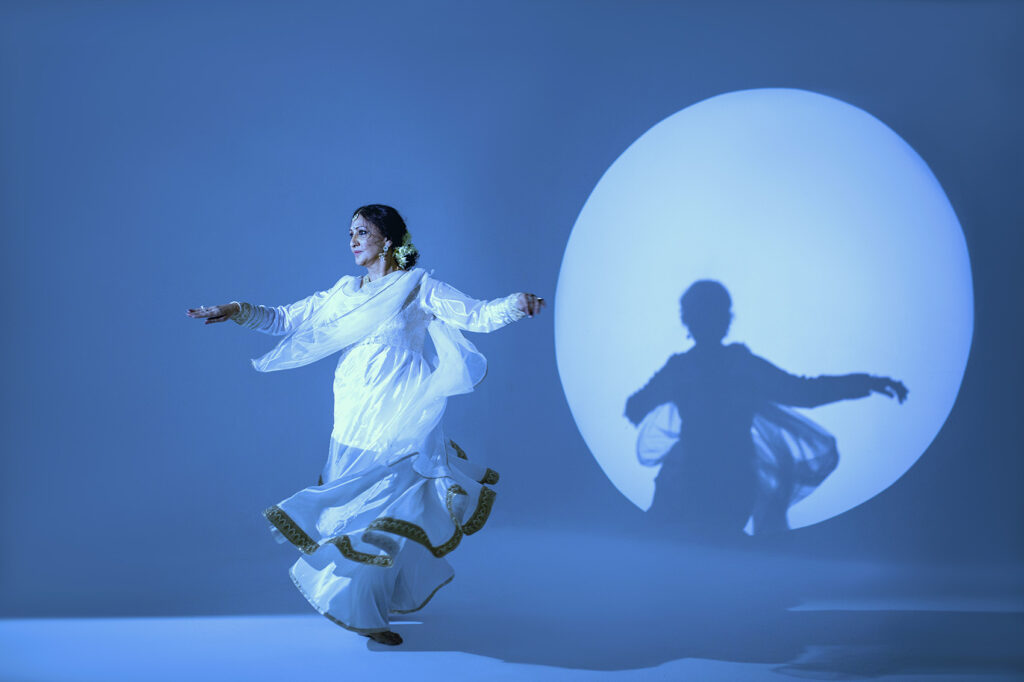
Kathak also places great emphasis on expressions, or “abhinaya.” Through subtle facial expressions, eye movements, and gestures, dancers evoke a wide range of emotions and tell captivating stories. From conveying the joy of celebration to expressing the depths of sorrow, the dancers’ ability to emote brings authenticity and depth to their performances.
Music plays a pivotal role in Kathak, with traditional compositions being accompanied by instruments such as the tabla, sitar, sarangi, and harmonium. The rhythmic patterns created by percussion instruments align harmoniously with the melodic strains of the string instruments, amplifying the dancer’s movements and immersing the audience in a captivating atmosphere.
Kathak is a dance form that demands both technical prowess and artistic expression. Years of dedicated training under the guidance of experienced gurus are essential to mastering the intricate footwork, complex rhythmic structures, and delicate hand movements. Aspiring Kathak dancers delve into the depths of improvisation techniques, technical intricacies, and an extensive repertoire of compositions.
Throughout its evolution, Kathak has incorporated classical and contemporary themes into its repertoire. While traditional compositions and mythological tales remain integral to the dance form, Kathak has embraced innovative choreographies that explore social, cultural, and abstract concepts. This ability to adapt and evolve has allowed Kathak to remain relevant and captivating in the modern era.
The history of Kathak reflects the influences it has received over time. Under the patronage of the Mughals, Kathak flourished in the royal courts, and a growing appreciation of this art led to an enhancement in the dance itself resulting in an emphasis on intricate technique, mathematically sophisticated footwork, and a complex use of rhythm and time measurement. Thus, kathak emerged stronger with the fusion of the two varying Hindu and Muslim cultures woven into its fabric.
In the 19th century, two distinct gharanas or schools of Kathak emerged. The Lucknow gharana focused more on expressive work and intricate gestures, while the Jaipur gharana excelled in powerful rhythmic technique. Kathak has also integrated Western influences into its performances through costumes, makeup, and stage effects.
In its contemporary form, Kathak embodies the spirit of the present times with influences from socialism, symbolism, realism, and Freud’s concept of life force. While staying true to its historical and cultural roots, Kathak represents a synthesis of diverse influences, resulting in mathematical permutations within a rhythmic cycle and a touch of mysticism. Its mesmerizing beauty makes Kathak a celebration of all the senses, creating an immersive experience that only life can fully do justice to.
Welcome to the enchanting world of Kathak, where storytelling, grace, and artistic brilliance converge to create a timeless celebration of culture and emotion. Immerse yourself in this captivating dance form that continues to captivate audiences while honoring its illustrious past and embracing the possibilities of the future.
Kathak Classes
Kathak Dance Training

Nighat Chaudhry, an exponent of Eastern mysticism and grace, embarked on her journey in London, where she discovered her passion for dance. For years, ballet and contemporary dance were her chosen methods of self-expression, until a fateful encounter at the age of fourteen with the renowned kathak dancer Nahid Siddiqui from Pakistan altered the course of her life. Initial training with Nahid Siddiqui sparked a deep inspiration within Nighat to delve deeper into the classical forms of her own culture.
In her quest to understand and absorb the intricate nuances of kathak, Nighat made the decision to abandon her pursuit of ballet. She believed that to truly connect with the essence of this traditional dance form, she needed to be in close proximity to its origins. Thus, her journey back to the East commenced, taking her from Lahore to Delhi and Bombay.
Training in the Lucknow and Jaipur Schools of Kathak under the guidance of esteemed Kathak masters like Nahid Siddiqui in London, Maharaj Ghulam Hussain Kathak in Lahore, Pandit Durga Lal in Delhi, Nighat’s dance journey unfolded over the years. Additionally, she had the privilege of attending workshops conducted by luminaries such as Pandit Birju Maharaj, Kumudinia Lakhia, and Saswati Sen – all of whom left an indelible mark on her training.
Nighat is presently training under Guru Pali Chandra who is not only a Kathak Guru and choreographer but celebrates accolades of being a Kathak art educationist and a pioneer of online kathak training. Under Pali Chandra Nighat studied the London based ISTD kathak syllabus and continues to expand and deepen her knowledge of Kathak as an art-form.
However, it is vital to acknowledge that Nighat’s transformation as a dancer extends beyond technical prowess and stylistic expertise. Alongside her rigorous dance training, Nighat has also cultivated her spiritual mentorship with her spiritual mentor and guide Syed Safdar Ali Qalandar Baba in Dhamal and Sufi dancing which plays an integral role in her journey as an artist.
Embracing the principles of Eastern mysticism, Nighat has seamlessly integrated spirituality into her dance practice. As she honed her skills under the tutelage of her revered gurus, she also imbibed their teachings on the profound connection between movement and the divine. This spiritual mentoring has helped Nighat tap into a deeper realm of artistry, allowing her to infuse her performances with an ethereal quality that transcends physicality.
The success Nighat has achieved as a Kathak dancer is a testament to the profound impact of her great teachers and her spiritual mentor. They have not only shaped her as a skilled artist, but also nurtured her inner journey, enabling her to portray mysticism and grace through her dance. Nighat’s devotion to both the technical aspects and the spiritual essence of Kathak exemplifies her commitment to preserving and sharing the rich cultural heritage of her own roots.